Cannabis Lab Testing in Maine
What every Maine dispensary operator needs to know about product testing
Maine Testing Requirements
| Legal Basis | Title 28-B, OCP Chapter 40; testing facilities follow Chapter 5 |
| Before Sale | Complete the tests required for the product matrix and documented input history |
| Flower Tests | Requirements depend on final form and intended sale or further processing |
| Concentrates | Requirements depend on extraction method and prior input testing |
| Edibles | Product-level tests plus contaminant rules tied to concentrate-input testing history |
| Cost per Sample | $50-300 |
| Monthly Budget | $2,000-10,000 for most shops |
Why Testing Matters
Maine requires adult-use cannabis and cannabis products to complete the mandatory testing applicable to their matrix, final form, and processing history before release to consumers. Prior compliant testing can matter; a universal “every product gets every panel again” rule is not an accurate operating summary.
Testing protects consumers and operators. A failed result blocks release, but Chapter 40 uses analyte- and product-specific retest, remediation, relabeling, transfer, and destruction rules rather than one automatic outcome for every failure.
Test Results Are Your Marketing
What Gets Tested
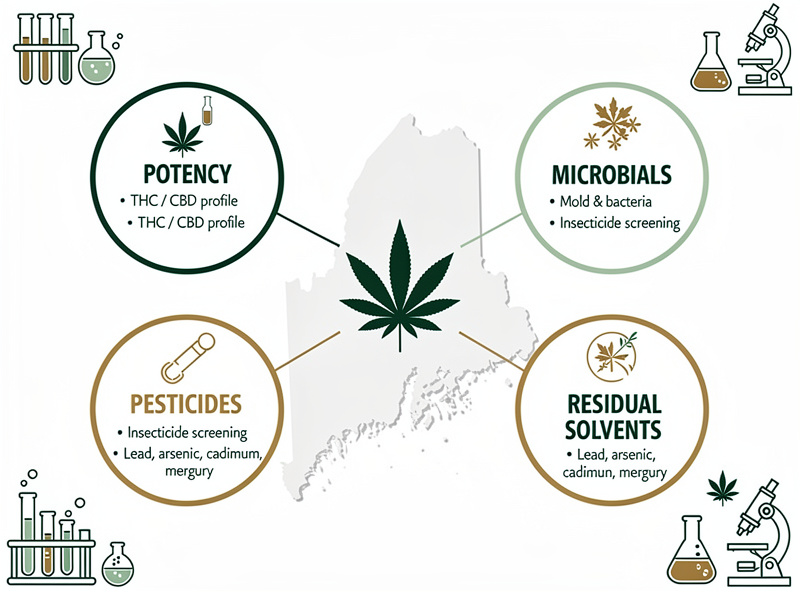
OCP's current Chapter 40 rule assigns testing by matrix, final form, intended transfer or sale, production method, and prior input testing. Do not order or describe one fixed panel without checking the rule and the batch's chain of processing.
Flower and trim
Requirements differ depending on whether plant material is in final form for sale to a consumer or will be processed into another product. Potency, microbes, pesticides, metals, water activity, and other categories apply as specified by Chapter 40.
Concentrates
Extraction method and earlier testing of flower or trim affect which contaminant and residual-solvent tests apply. Preserve the certificates of analysis that support reliance on earlier testing.
Edibles
Current Maine law already provides a concentrate-input exception. Under 28-B M.R.S. § 605(4), as amended by P.L. 2025, ch. 764 effective April 19, 2026, using cannabis concentrate to create an edible is not further processing requiring additional testing when § 605's prior-testing, documentation, and tracking conditions are met, except for THC-potency, homogeneity, and cannabinoid-profile testing under § 602(1)(F). OCP's April 28, 2026 implementation guidance says the change applies effective immediately. The exception applies only when every cannabis concentrate input used in the edible has passed all required mandatory contaminant testing. It directs qualifying finished-edible submissions to select Potency (infused) and Homogeneity, and its conclusion confirms that THC-potency, cannabinoid-profile, and homogeneity testing remain mandatory. OCP's July 2026 Chapter 40 draft would incorporate that statutory exception into the rule. The statutory exception and OCP guidance are effective now; the draft's other changes remain proposed.
Other product matrices
Topicals, tinctures, inhalable products, and other matrices do not share one universal panel. Confirm the applicable Chapter 40 category and current OCP guidance with the testing facility before sampling.
The Testing Process
Testing starts before you harvest. A lab tech visits your facility. They take samples from your batch. Each sample must represent the whole lot. The lab then runs the required panels.
Results come back in 5 to 10 days. Faster service costs more. Most operators plan for the standard turnaround. Rush testing is available but runs 2-3x the normal price.
If results pass, you get a Certificate of Analysis (COA). This document proves your product is clean. You attach it to your inventory in Metrc. Then you can sell.
What Happens When Tests Fail
A failed result prevents release for sale, but the permitted next step depends on the analyte and product matrix. Follow the current Chapter 40 retest and remediation procedure and preserve each result in Metrc.
Retesting without remediation
Chapter 40 provides a two-sample retest pathway through the same testing facility for a batch that failed mandatory testing. Both retest samples must pass the testing required for the analyte that failed.
Remediation
Some failed batches may be remediated and retested. Pesticide and heavy-metal failures may be retested but may not be remediated under the current rule. Matrix changes and yeast-or-mold failures can trigger additional testing requirements.
Potency failures
Do not assume that relabeling, destruction, or one retest is automatically sufficient. The current final Chapter 40 rule requires two samples for retesting without remediation, and both must pass the testing required for the initially failed analyte. OCP's July 2026 draft would add use of the higher passing potency result for labeling; only that labeling treatment remains proposed until final adoption.
Destruction
Destruction is required in specified circumstances, including certain failed retest outcomes, but it is not the universal first step after every failed result. Confirm the applicable subsection before acting.
Choosing a Maine Lab
Four labs operate in Maine. All are certified by the OCP. Some operators also use labs in nearby states. All testing must meet Maine standards regardless of lab location.
| Factor | What to Check |
|---|---|
| OCP License | Must be licensed in Maine |
| ISO 17025 | Accreditation shows quality standards |
| Turnaround | 5-10 days standard, faster costs more |
| Sample Size | Typically 5-10 units per batch |
| Cost | $50-300 per sample depending on panel |
| Communication | Fast results delivery matters in this business |
Testing Costs
Budget for testing like any other operational cost. Here is what Maine operators typically pay.
| Test Type | Cost | Notes |
|---|---|---|
| Flower full panel | $150-250 | Per batch sampled |
| Concentrate panel | $200-300 | Includes residual solvents |
| Edible panel | $150-250 | Per batch sampled |
| Rush testing | 2-3x standard | Available at high-quality price |
| Monthly budget | $2,000-10,000 | Based on sales volume |
Volume discounts exist. Labs negotiate on batches of 20 or more per month. Build a relationship with your lab. The savings add up.
The M.R.S. Title 28-B Citations
Several sections of Maine law govern testing. Know these key citations.
- Section 601 — Adult-use cannabis testing program
- Section 504 — Cannabis store operational rules
- Section 701 — Labeling requirements tied to test results
- Section 703 — Health and safety restrictions
Working with Cultivators
Most dispensaries buy products from cultivators, not grows their own. Your supplier's testing habits affect your business.
Ask your cultivators about their testing process. Ask for recent COAs before you buy. This protects you from inheriting their failures.
Build relationships with cultivators who test thoroughly. They tend to have cleaner products. Their reliability saves you money over time.
Key Takeaways
- Complete the Chapter 40 tests required for the product matrix and documented input history before sale
- Different final forms and processing histories require different tests
- Failed results require the analyte- and matrix-specific retest, remediation, or destruction pathway
- Testing facilities must be OCP-certified
- Get current written lab quotes instead of relying on a universal testing budget
- Keep certificates of analysis and chain-of-custody records with the batch
This guide is for informational purposes only. It does not constitute legal advice. Consult the Maine OCP and qualified legal counsel for compliance questions.
Maine OCP Testing Requirements in Detail
The Office of Cannabis Policy sets adult-use sampling and product-testing requirements in Chapter 40; Chapter 5 governs certification and operation of cannabis testing facilities. Applicable testing depends on the product matrix, final form, prior compliant input testing, and chain of processing. A certificate of analysis must document the mandatory testing used to support release.
OCP inspectors conduct random sampling at licensed facilities. During an inspection, inspectors may collect samples from your inventory for independent testing. If the independent test results differ significantly from your submitted COAs, OCP may launch a formal investigation. This makes it essential to maintain chain-of-custody documentation for all tested products.
The required testing panels change periodically as OCP updates its rules. In 2025, OCP proposed adding additional pesticide compounds to the screening list after reports of elevated pesticide contamination in products from other states. Operators should monitor OCP guidance for updates and subscribe to Maine Cannabis Industry Association notifications to stay current on regulatory changes.
Licensed Testing Laboratories in Maine
Maine has multiple OCP-licensed testing laboratories that serve the adult-use market. Each lab maintains accreditation to ISO 17025 standards, which demonstrates analytical accuracy and repeatability. However, labs differ in their capacity, pricing, and failure rates.
When selecting a testing lab, operators should consider several factors beyond just price. Turnaround time matters because products cannot be sold while awaiting results. Standard turnaround is five to ten business days. Rush service typically costs two to three times more but can reduce wait time to two to three business days. If you are working with perishable inventory or have time-sensitive product launches, factor turnaround into your lab selection.
Failure rates reveal a lab is strict but also create operational risk. A lab with a 15% failure rate means roughly one in seven batches gets rejected. That creates serious problems if you rely on a single lab. Operators should maintain relationships with at least two labs. Your primary lab handles routine testing. Your backup lab handles overflow and provides a second opinion when results are disputed.
Ask other Maine operators which labs they use and why. Word spreads quickly about labs with inconsistent results or slow customer service. The Maine cannabis community is relatively small, and operators share information about reliable partners.
Common Contaminants in Maine Cannabis Products
Microbial Contamination
Microbial contamination is the most common reason for failed tests in Maine. Mold and bacteria develop when cannabis is stored in humid conditions or handled improperly during processing. Aspergillus, a mold that can cause serious health problems, is specifically tested for in Maine because it poses inhalation risks.
Preventing microbial contamination starts at the cultivation level. Facilities should maintain relative humidity below 60% during flowering and ensure proper air circulation. After harvest, cannabis must dry and cure correctly before storage. Operators who source from cultivators with poor storage practices will face higher failure rates regardless of their own handling.
If a batch fails for microbial contamination, hold it from sale and follow Chapter 40's retest or remediation pathway. The permitted process depends on the matrix and failed analyte, and yeast-or-mold failures can trigger mycotoxin testing on retest. Document each result and final disposition in Metrc.
Pesticide Contamination
Pesticides used during cultivation can leave residues that persist through processing and sale. Maine tests for more than 60 different pesticide compounds. Operators should request testing history from cultivators before purchasing inventory to identify products with elevated pesticide risk.
The most common pesticide failures in Maine involve products grown in other states where pesticide regulations are less strict. If you source flower from out-of-state cultivators, verify their testing meets Maine standards. Out-of-state products must meet or exceed Maine thresholds to be sold here.
Heavy Metal Contamination
Heavy metals including lead, cadmium, arsenic, and mercury accumulate in cannabis plants that grow in contaminated soil or are fed nutrients containing heavy metals. This contamination typically originates from the growing medium, not from processing. Cultivators using organic soil amendments should test their soil periodically to ensure heavy metal levels remain safe.
Heavy-metal failures may not be remediated under the current Chapter 40 rule, but they may use the rule's two-sample retest pathway. Destruction follows if the applicable retest outcome requires it. This makes source verification critical; ask cultivators about soil testing and growing-medium controls.
Residual Solvent Contamination
Concentrates made with solvents must meet the applicable Chapter 40 action limits. If a batch fails residual-solvent testing, hold it from sale and follow the matrix-specific retest or remediation pathway rather than assuming one automatic outcome.
Closed-loop extraction systems produce cleaner concentrates than open-loop systems because they capture and recycle solvents rather than releasing them into the atmosphere. Ask your extraction partner about their equipment and process. Closed-loop operators generally produce concentrates with lower residual solvent levels.
Interpreting Certificate of Analysis
A Certificate of Analysis lists test results for each contaminant panel. The COA shows whether a product passed or failed each test and provides the actual measured values for quantitative tests. Understanding how to read a COA helps you catch problems before selling products.
Potency results show measured cannabinoid values. When a potency result fails an applicable labeling standard, hold the batch and follow the current Chapter 40 retest process. The current final rule requires two samples for retesting without remediation, and both must pass the testing required for the initially failed analyte. OCP's July 2026 draft would add use of the higher passing potency result for labeling; only that labeling treatment remains proposed until final adoption.
Action limits versus detection limits matter. Some contaminants have a maximum allowed concentration. Others have a minimum detection threshold. A result that shows ND means not detected at the method detection limit. It does not mean zero. It means the lab could not detect the compound at the level their equipment can reliably identify.
COAs should travel with product through the supply chain. When you receive inventory from a cultivator or manufacturer, verify the COA accompanies the shipment. Products without valid COAs cannot be entered into Metrc for sale. Keep copies of all COAs in your records for at least three years, as OCP may request documentation during inspections or audits.
Managing Testing Costs
Testing costs vary based on product type and panel complexity. Flower testing runs $50-$150 per sample. Concentrate testing costs more because it includes residual solvent analysis, typically $100-$250 per sample. Edible testing falls in a similar range to concentrates at $75-$200 per sample depending on the number of products in the batch.
Budget planning should account for testing as a recurring operational cost, not a one-time expense. Every batch of products you sell requires testing documentation. Monthly testing budgets for a typical dispensary range from $2,000-$10,000 depending on sales volume and product mix. Operators with high inventory turnover or those selling concentrates and edibles face higher testing costs than those focusing primarily on flower.
Some operators attempt to reduce costs by batching products together. This works if products come from the same source and are similar in composition. However, OCP rules require each distinct product SKU to carry its own COA. You cannot test a large batch and use those results for multiple product variations that have different strains or THC profiles.
What Happens During an OCP Inspection
OCP inspectors may visit your facility to collect samples for independent testing. During these inspections, they will review your testing documentation, chain-of-custody records, and COA files. They will verify that all products in your inventory have valid, unexpired test results.
Inspectors look for patterns suggesting product manipulation. If your Metrc inventory shows product that should have failed based on historical testing data from the same source, inspectors may investigate further. Maintaining accurate records that show clear supply chain documentation protects you during these inspections.
If an OCP inspection reveals products without valid COAs or with discrepancies between reported and actual test results, you face enforcement action. Penalties range from fines to license suspension. In serious cases involving product that poses health risks, OCP may pursue license revocation.
Editorial note. This guide is part of the Maine Dispensary Guide editorial corpus. Every material correction to this page is documented in our public Editorial Corrections Log with the primary source that confirms the fix.