Cannabis Zoning & Real Estate
Finding the right location for your Maine cannabis dispensary
Overview
import Callout from '@network/ui/Callout'; export default Callout;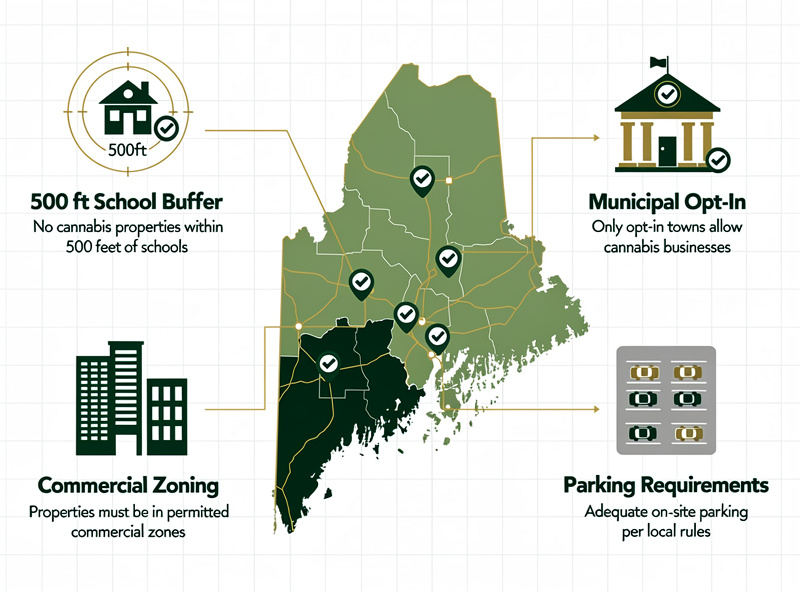
Finding the right location is one of the most critical — and most frequently misunderstood — decisions for any prospective Maine dispensary owner. Under 28-B M.R.S. §301, Maine municipalities hold the primary authority to decide where cannabis businesses can operate within their borders. That means dispensary zoning in Maine is inherently local: the state issues your license, but your city or town sets the rules for where you can actually be.
Before you sign any lease, pay any deposit, or commission any build-out work, you need a clear picture of the cannabis zoning requirements Maine imposes at both the state and local levels. This guide walks through every layer — from the municipal opt-in mechanism to school buffer distances to the mechanics of a local zoning hearing — so you can evaluate a potential site with confidence.
Maine's Municipal Opt-In System
Maine's adult-use cannabis law does not automatically allow dispensaries to operate in every town. Instead, 28-B M.R.S. §301 creates a municipal opt-in framework: each municipality must affirmatively pass a local ordinance permitting cannabis retail operations before the Maine Office of Cannabis Policy (OCP) will approve a license for that location.
In practice, this means you must confirm two separate approvals before your dispensary can open:
- Municipal opt-in status — the town or city has adopted an ordinance allowing adult-use retail cannabis.
- Local zoning permit — your specific site meets the conditions of that ordinance (correct zone, buffer clearance, parking, signage, hours, etc.).
As of 2026, roughly 60% of Maine's 492 municipalities have opted in — concentrated heavily in larger communities and coastal tourist towns. Many rural communities remain opted out, either by explicit vote or by never having taken up the question. For a current town-by-town breakdown, see our Maine Cannabis Opt-In Tracker.
Why it matters: If you sign a lease in a municipality that has not opted in, the OCP will not issue you a license — full stop. No workaround exists. You must either wait for the municipality to opt in (which can take years) or find a different location. Never commit to real estate before confirming opt-in status.
School Buffer Requirements: 500 ft vs. 1,000 ft
Maine law prohibits cannabis retail locations within a specified distance of schools. The exact requirement depends on municipal ordinance:
| Buffer Distance | When It Applies | Measured How |
|---|---|---|
| 1,000 ft (state default) | Applies where the municipality has not specified a different distance in its ordinance | Property line to property line (not door to door) |
| 500 ft (reduced municipal option) | Municipalities may reduce to 500 ft via local ordinance; some urban markets (Portland, Bangor) have done so | Property line to property line |
◆ Covered institutions include K–12 public and private schools. Some local ordinances extend the buffer to include daycare centers and playgrounds — always review the specific municipal ordinance text, not just the state statute.
◆ Measurement matters. The buffer is measured from the nearest property line of the school parcel to the nearest property line of the proposed cannabis retail parcel — not between building entrances. A site that looks distant on a map can fail the buffer if the school's athletic fields extend the relevant property line significantly closer.
Before finalizing any site, obtain a surveyor's measurement or use your municipality's GIS mapping tool to confirm buffer compliance. Do not rely on Google Maps estimates.
Key Zoning Requirements at a Glance
| Requirement | State Baseline | Local Variation |
|---|---|---|
| Municipal opt-in | Required — OCP will not license in non-opt-in towns | Each municipality votes separately |
| School buffer | 1,000 ft (property line to property line) | May be reduced to 500 ft by local ordinance |
| Permitted zoning district | Commercial or industrial; residential is prohibited | Municipalities specify exact zone names in ordinance |
| Parking | No state minimum; determined locally | Typically 4–8 spaces per 1,000 sq ft of retail |
| Signage | No cannabis leaf symbol visible from public way | Local sign ordinances also apply |
| Hours of operation | No state restriction on hours | Many municipalities cap at 9 PM or 10 PM |
| Co-location with alcohol | Prohibited — cannot share a premises with a liquor license | No local relaxation permitted |
Commercial Zoning Districts: Where Dispensaries Are Permitted
Maine cannabis stores must operate within commercially or industrially zoned parcels. Residential zones are categorically prohibited regardless of proximity to any school. Within the commercial zoning universe, the specific districts where dispensaries are allowed depend on each municipality's ordinance language.
In most opted-in municipalities, adult-use cannabis retail is permitted as-of-right (no special permit required beyond the local cannabis permit) in:
- General Commercial (C-1, C-2, CB) — the most common zone type; includes strip malls, shopping centers, downtown main street corridors
- Highway Commercial (HC) — typically auto-oriented; common near Route 1 and arterials in southern Maine
- Industrial / Light Industrial (I-1, LI) — often attractive for lower rents; some municipalities allow retail-facing dispensaries here, others restrict industrial zones to cultivation/processing only
Some municipalities create a dedicated Cannabis Overlay District or use conditional use permits (CUPs) rather than as-of-right approval. Conditional use permits require a public hearing and impose discretionary conditions — a longer, less certain process than as-of-right approval.
▲ Tip: When scouting locations in a new market, pull the municipality's zoning map and the full text of its cannabis ordinance before engaging a broker. Brokers who do not specialize in cannabis often show you spaces in zones that will not be approved.
State License vs. Local Permit: Two Separate Tracks
One of the most common strategic mistakes in Maine cannabis real estate is conflating the state licensing process with local zoning approval. They are separate processes that run on separate timelines — and each can kill your project independently. For a complete visual plan of how these tracks fit together from start to finish, see our step-by-step guide to opening a dispensary in Maine.
- State license (OCP): Issued by the Maine Office of Cannabis Policy. Requires demonstration of a compliant location, but the OCP will not begin substantive review of your application until you have a local permit in hand. See our Maine Dispensary License Guide for the full OCP process.
- Local permit: Issued by your municipality (typically through the planning board, code enforcement office, or licensing board). This is the approval that confirms your specific site meets local cannabis zoning requirements in Maine. The OCP requires evidence of local approval as a condition of state licensure.
The sequencing matters: you generally need the local permit before the OCP will finalize your state license. But the local permit application often requires you to demonstrate that you have site control (a signed lease or purchase agreement). This creates a timing challenge — you must commit to real estate before you have your state license, meaning your lease must include appropriate contingency language.
Work with a cannabis-experienced real estate attorney to draft lease contingency provisions that allow you to exit the lease without penalty if the state or local license is denied.
Timeline for Municipal Approval
Municipal approval timelines for cannabis zoning requirements in Maine vary significantly by town. As a planning baseline:
- Simple as-of-right permit: 2–6 weeks in municipalities with a streamlined cannabis licensing ordinance and no public hearing requirement
- Conditional use permit (CUP): 45–90 days from application submission, including mandatory public notice and hearing periods
- Overlay district review: 30–60 days; varies by planning board meeting schedule (most boards meet monthly)
- Contested applications: 3–6 months or longer if neighbors appeal or the planning board continues the hearing
Factor these timelines into your overall launch plan. If your target market has a monthly planning board that requires a 30-day public notice period before a hearing, you could be 90–120 days from application submission to permit issuance even for a straightforward application. See our Maine Cannabis Regulations Guide for the broader regulatory calendar.
Common Reasons for Zoning Denial
Understanding why applications fail helps you avoid the same traps. The most frequent grounds for municipal denial of cannabis zoning applications in Maine:
- Buffer violation: The site is within 1,000 ft (or 500 ft in reduced-buffer municipalities) of a school property line. This is a hard disqualifier — no variance is available under state law for the school buffer.
- Wrong zoning district: The parcel is zoned residential or in a commercial district the ordinance excludes from cannabis retail.
- Inadequate parking: The site does not meet the municipality's parking ratio for cannabis retail uses.
- Proximity to another cannabis retailer: Some municipalities impose minimum spacing requirements between cannabis stores (typically 500–1,000 ft), separate from the school buffer.
- Neighborhood opposition: For conditional use permits, strong neighbor opposition can lead the planning board to deny on grounds of traffic, noise, or character impacts — even if the technical requirements are met.
- Incomplete application: Missing documentation (site plan, operating plan, security plan, proof of site control) results in application rejection or denial without prejudice.
If your application is denied, many municipalities allow an appeal to the Board of Appeals within 30 days. Denial with prejudice (which prevents re-application for a set period) is rare but does occur. For guidance on navigating denial, see our License Denial Guide.
How to Research a Potential Location Before Signing a Lease
The due diligence checklist for a Maine dispensary site should happen before you negotiate any commercial terms. Here is a practical sequence:
- Confirm opt-in status. Check the opt-in tracker and verify directly with municipal staff. Opt-in status can change — municipalities can also opt back out (though existing licenses are typically grandfathered).
- Pull the current zoning map and cannabis ordinance text. Verify the parcel's zone designation and confirm it appears in the ordinance's list of permitted zones for cannabis retail.
- Measure the school buffer. Identify all school parcels within 1,500 ft of the site. Use the municipality's GIS tool to measure property-line-to-property-line distance. If you're within 200 ft of the buffer threshold, hire a surveyor.
- Check for competing cannabis stores. If the municipality has a proximity restriction between cannabis retailers, identify existing licensees and map the restricted radius around each.
- Review parking, signage, and hours. Confirm the site meets or can be made to meet all local requirements before committing to a lease.
- Meet with the code enforcement officer or planning staff. A pre-application meeting is usually free and can surface issues before you've spent money on plans and applications. Planning staff can often tell you informally whether a site is likely to be approved.
- Draft contingency language into your letter of intent and lease. Your attorney should include provisions making the lease contingent on receipt of all required cannabis permits and licenses within a defined period.
For an overview of available dispensary locations across Maine's key markets, see our Maine Dispensary Locations Guide, which tracks active dispensaries city by city.
Frequently Asked Questions
import Faq from '@network/ui/Faq'; export default Faq;External Resources
Disclaimer: This guide is for informational purposes only and does not constitute legal or financial advice. Cannabis regulations are subject to change; always consult with the Maine Office of Cannabis Policy and qualified legal counsel.