Maine Dispensary License Requirements
The complete guide to obtaining your cannabis business license in Maine — OCP requirements, license types, fees, and application plan for 2026
License at a Glance
| Licensing Authority | Maine Office of Cannabis Policy (OCP) |
| Legal Basis | 28-B M.R.S. Chapter 1, OCP Rule Chapter 2 |
| Retail License Fee | $500 application + $2,500 annual renewal |
| Processing Time | 60–120 days for complete applications |
| Residency Requirement | Maine business entity required; out-of-state ownership permitted |
| Mandatory Tracking | Metrc seed-to-sale for all licensees |
| Active Dispensaries | 169+ licensed adult-use stores statewide (2026) |
| OCP Portal | maine.gov/dafs/ocp |
Overview — Why Maine Is Worth the Effort
Maine's adult-use cannabis market generated $244 million in retail sales in 2024, with the medical program adding another $280 million. The combined market has surpassed a half-billion dollars annually — making cannabis Maine's single most valuable agricultural product, ahead of both blueberries and potatoes. The opportunity is real. But so is the regulatory complexity.
The Office of Cannabis Policy (OCP), a division of the Department of Administrative and Financial Services, administers both the adult-use and medical cannabis programs. The agency publishes detailed application guidance, maintains an online licensing portal, and conducts compliance inspections. Understanding how the OCP works — what it requires, how it evaluates applications, and what triggers denials — is the difference between a successful launch and a wasted application fee.
The good news: Maine has one of the most mature and predictable licensing systems in the Northeast. The agency has been operating since 2015 (medical) and 2020 (adult-use). Processing timelines are reasonable. The regulatory framework is stable. For operators who do the homework and prepare complete applications, Maine has a genuine pathway to profitability in one of New England's most underserved cannabis markets.
Maine's Cannabis License Types
Maine has seven distinct cannabis license categories. Most dispensary operators need the Cannabis Store (adult-use retail) license. Medical dispensaries require a separate Medical Dispensary registration. Most new applicants pursue the adult-use retail license first, then add medical endorsement or vertical integration licenses as they grow.
Maine's licensing framework under 28-B M.R.S. Chapter 1 establishes the following license types:
| License Type | Function | Annual Fee |
|---|---|---|
| Cannabis Store | Adult-use retail sales (21+) | $2,500 |
| Medical Dispensary | Medical cannabis sales to registered patients | $500–$3,000 |
| Cultivation (Tier 1–4) | Growing operations, 2,000 sq ft to unlimited canopy | $1,000–$10,000 |
| Products Manufacturing | Concentrates, edibles, topicals production | $2,500 |
| Courier | Delivery-only operations | $1,000 |
| Testing Facility | Cannabis product laboratory analysis | $1,500–$3,000 |
| Micro-Business | Small-scale cultivation + retail on same premises | $500 |
Which License Does a Dispensary Need?
For a standard retail dispensary selling cannabis products to adult-use consumers, the Cannabis Store license is the primary requirement. If you intend to sell to both adult-use customers and medical patients, you need the Cannabis Store license with a Medical Dispensary endorsement — a dual authorization that lets you serve both markets from the same location.
The endorsement approach is common among established Maine operators. It adds minimal cost (the medical endorsement fee is lower than a standalone medical license) and gives you access to the 112,000+ registered medical patients in Maine. Patients often have higher purchase limits and different product preferences — a valuable market segment.
Eligibility Requirements — Who Can Apply?
To qualify for a Maine cannabis license, you must be 21 or older, form a Maine-registered business entity, disclose all beneficial owners with 10%+ interest, pass criminal background checks, and secure municipal authorization for your proposed location. Out-of-state ownership is permitted but subject to heightened scrutiny.
The fundamental eligibility requirements are established under 28-B M.R.S. §101 and OCP Rule Chapter 2. Here is what the OCP requires from every applicant:
Age and Identity
All natural persons with a financial interest in the applicant entity must be at least 21 years of age. This includes sole proprietors, LLC members, corporate officers, and anyone holding a 10% or greater economic interest. The OCP requires government-issued photo identification as part of the application.
Maine Business Entity
You must establish a legal business entity registered with the Maine Secretary of State before applying. Acceptable entity types include limited liability companies (LLC), corporations, and limited partnerships. Sole proprietors cannot hold a cannabis license. The entity must maintain a registered Maine address — a PO Box is not sufficient for the physical business address.
Beneficial Ownership Disclosure
The OCP requires disclosure of ALL beneficial owners — defined as any person with 10% or more direct or indirect economic interest in the entity. This is not optional. Silent partners, passive investors with profit-sharing arrangements, family members whose contributions appear on title or loan documents, and anyone receiving a percentage of gross or net revenue must be disclosed. Failing to identify a beneficial owner is one of the most common reasons licenses are later revoked. If you are uncertain whether someone qualifies as a beneficial owner, disclose them anyway — it is better to over-disclose than to have an undisclosed interest surface during a compliance audit.
Criminal Background Checks
All individuals subject to beneficial ownership disclosure must submit to a criminal history records check through the Maine State Police and the FBI. Disqualifying convictions include:
- Convictions related to the manufacture, distribution, or trafficking of controlled substances within the past 10 years
- Convictions involving fraud, embezzlement, or financial crimes related to a business within the past 10 years
- Any conviction that would disqualify the applicant from holding a state-issued professional license
Each application is evaluated individually. Prior convictions do not automatically disqualify all applicants — the OCP considers the nature of the conviction, the time elapsed, and evidence of rehabilitation. However, applicants with recent drug trafficking convictions should expect denial.
Municipal Authorization
This is the requirement most applicants underestimate. Before the OCP will process your application, you must have written authorization from the municipality where you intend to operate. Maine's cannabis framework is an opt-in system — municipalities must affirmatively vote to allow cannabis businesses within their borders. A dispensary operating in a municipality that has not opted in is operating illegally regardless of its state license.
Municipal authorization requirements vary by town. Some require a formal application to the planning board or town council. Others require only a letter from the code enforcement officer confirming the proposed location is in a properly zoned district. Some towns charge additional local licensing fees. Always get written confirmation from your municipal authority before committing to a location.
import Callout from '@network/ui/Callout'; export default Callout;The Application Process — Step by Step
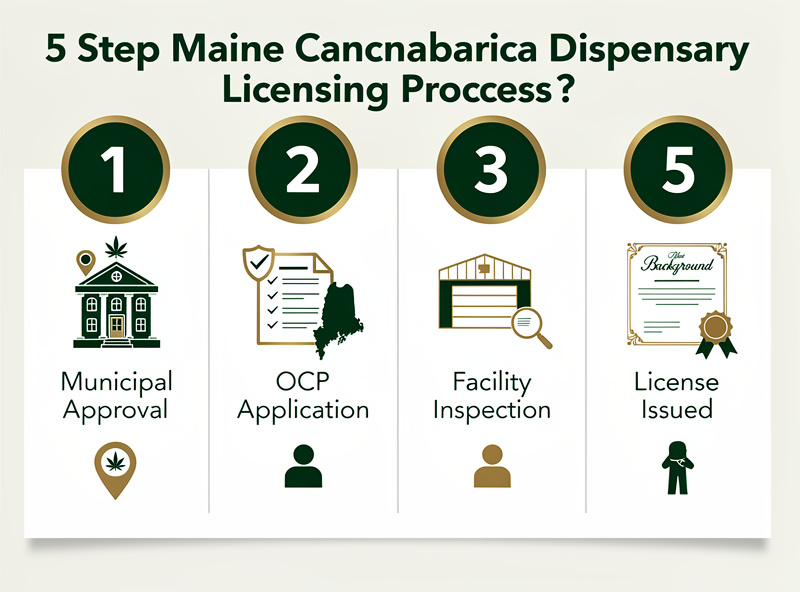
The Maine licensing process takes 3–6 months from submission to approval for complete applications. For a complete visual plan of the entire process from concept to opening day, see our step-by-step guide to opening a dispensary in Maine. The process requires: (1) business entity formation, (2) municipal approval, (3) OCP application submission, (4) facility inspection, and (5) license issuance. Incomplete applications are the #1 cause of delays.
Step 1: Form Your Business Entity (2–4 Weeks)
Register your business with the Maine Secretary of State. Choose an LLC, corporation, or another permissible entity type. Engage a Maine-registered agent if your entity is formed out of state. This step also includes drafting your operating agreement and establishing your initial financial accounts. You will need your entity documents ready before the OCP application, as you must provide your Maine business ID number on the application form.
Step 2: Secure Your Location and Municipal Approval (4–12 Weeks)
Identify a commercially zoned property in an opted-in municipality. Execute a lease or purchase agreement contingent on licensing. Submit your municipal application — the required documentation varies by town but typically includes a site plan, operational description, security plan, and community impact statement. Municipal approval timelines range from 4 weeks to 6 months depending on the municipality and whether public hearings are required. Budget generously here — municipal delays are the leading cause of timeline overruns.
Step 3: Prepare Your OCP Application (4–8 Weeks)
While your municipal application is pending, prepare your OCP submission. The OCP application requires:
- Completed license application form (available on the OCP website)
- Articles of Organization or Incorporation from the Maine Secretary of State
- Operating Agreement (for LLCs) or Bylaws (for corporations)
- Registered agent information
- All beneficial owners: full legal name, date of birth, social security number, address, background check authorization
- Source of funds documentation: bank statements, gift letters, loan documents, investment agreements — every dollar must be documented and traceable
- Municipal authorization letter confirming the location is approved for cannabis operations
- Security plan: physical security, video surveillance specifications, alarm system details, access control measures
- Standard operating procedures (SOPs) for inventory management, sales, security, and compliance
- Floor plan of the proposed facility
- Proof of financial viability: either $50,000 in liquid assets or a line of credit in the business name
- Application fee payment
Step 4: Submit and Respond to OCP Inquiries (60–120 Days)
Submit your complete application through the OCP's online portal. The agency will conduct an initial completeness review within 15 business days. If your application is incomplete, you will receive a deficiency notice specifying what is missing. Respond promptly — the OCP does not hold your place in queue indefinitely. For complete applications, the OCP typically completes its substantive review within 60–120 days.
Step 5: Facility Inspection (1–2 Days)
Once the OCP approves your application, it will schedule a pre-licensing inspection of your facility. The inspector will verify that your physical location matches the floor plan submitted, that security infrastructure is installed and operational, that your SOPs are implemented, and that Metrc tracking is configured. Resolve all deficiencies identified during inspection before requesting final license issuance.
Step 6: License Issuance
After a successful inspection, the OCP will issue your license by mail and email. Your license is valid for one year from the date of issuance. You must display your license prominently at your place of business.
| Phase | Duration | Key Deliverables |
|---|---|---|
| Business Entity Formation | 2–4 weeks | Maine SOS registration, operating agreement |
| Municipal Approval | 4–12 weeks | Written authorization, site plan approval |
| OCP Application Prep | 4–8 weeks | Complete application package, source of funds docs |
| OCP Review | 60–120 days | Responsive to deficiency notices |
| Pre-Licensing Inspection | 1–2 days | Facility compliance walk-through |
| Total to Licensed | 4–9 months | — |
Fees and Financial Requirements
The Cannabis Store license costs $500 to apply and $2,500 annually to renew. However, total startup costs for a Maine dispensary typically run $300,000–$700,000, encompassing location build-out, security systems, initial inventory, working capital, and licensing fees. Budget $50,000 minimum in liquid assets or a business line of credit to qualify.
State Licensing Fees
| Fee Type | Amount |
|---|---|
| Adult-Use Retail Application | $500 per location |
| Annual Renewal (Cannabis Store) | $2,500 |
| Medical Dispensary Endorsement | $500–$3,000 (based on gross revenue) |
| Change of Ownership Application | $500 |
| License Modification (location, etc.) | $100–$250 |
Municipal Fees
Municipal fees vary significantly across Maine. Some towns charge no additional local fee. Others charge $500–$5,000 per location. A few municipalities have enacted annual local cannabis taxes ranging from 0.5% to 2% of gross sales. Before committing to a location, obtain a complete schedule of all local licensing fees and taxes from the town clerk or finance department.
The $50,000 Financial Viability Requirement
The OCP requires proof of financial viability as part of every application. You must demonstrate either (a) $50,000 in liquid assets held in the business entity's name, or (b) a business line of credit or loan commitment of at least $50,000. This is a minimum threshold — most successful applicants show significantly more. The OCP evaluates whether the applicant has sufficient capital to sustain operations through the ramp-up period before reaching profitability. A dispensary typically takes 12–18 months to reach break-even, so many operators budget 18 months of operating expenses as their demonstrated financial viability.
Startup Cost Benchmarks
| Cost Category | Typical Range |
|---|---|
| Licensing & Legal | $15,000–$30,000 |
| Location Build-Out | $150,000–$400,000 |
| Security Systems | $25,000–$50,000 |
| Initial Inventory | $50,000–$100,000 |
| POS & Technology | $10,000–$20,000 |
| Working Capital (12–18 months) | $150,000–$300,000 |
| Total Estimated Startup | $300,000–$700,000 |
What the OCP Looks For — Hidden Evaluation Criteria
The OCP evaluates applications against six undisclosed criteria: completeness, financial viability, operational feasibility, community impact, compliance history, and public safety. Understanding these evaluation dimensions helps you anticipate concerns and strengthen your application proactively.
Completeness and Attention to Detail
Incomplete applications are the leading cause of delays and denials. Every field on the application must be filled. Every required document must be attached. Every beneficial owner must be listed. The OCP's review team does not chase incomplete applications — they issue deficiency notices or deny outright. Retain a cannabis-experienced attorney or consultant to review your application before submission.
Source of Funds Documentation
The OCP scrutinizes the origin of every dollar in your application. Be prepared to produce:
- Personal and business bank statements for the prior 24 months
- Gift letters for any contributed funds (signed by the donor, with evidence of the donor's own bank statements)
- Loan documentation showing the terms and the collateral backing the loan
- Investment agreements showing the financial arrangement with any equity investors
- Tax returns for the prior two years for all beneficial owners
Funds that appear突然ly in bank accounts without clear documentation of origin will trigger a denial. The OCP uses FinCEN Bank Secrecy Act guidance to evaluate cannabis business applications, and unexplained wealth is a disqualifying factor.
The Beneficial Ownership Trap
As of 2024, the OCP applies a strict 10% beneficial ownership threshold for disclosure. Any person who receives any form of economic benefit from the cannabis business — including but not limited to dividends, profit distributions, royalties, management fees, or loan interest — must be disclosed as a beneficial owner if their economic interest totals 10% or more. This includes family members, friends, and business partners who may be involved in the business without formal equity documentation. Overlooking a beneficial owner because there is no formal written agreement is a serious compliance risk.
Municipal Support
The OCP evaluates whether the municipality in which you intend to operate supports your application. A letter from the mayor, town council president, or planning board chair in support of your application carries significant weight. Conversely, if the municipality has expressed opposition to cannabis businesses generally, the OCP may view your application more skeptically. Building genuine community relationships before you apply is not just good practice — it is a strategic advantage in the review process.
Operational Requirements Once Licensed
Once licensed, Maine dispensaries must comply with OCP operational rules covering security, inventory tracking, purchase limits, employee training, and product sourcing. Violations can result in fines, mandatory corrective action plans, or license suspension.
Security Requirements
Every licensed dispensary must maintain 24/7 security infrastructure including:
- Professional-grade video surveillance covering all entry and exit points, the sales floor, vault, and any area where cannabis products are stored or handled
- Silent alarm system connected to a monitoring service
- Secure, locked vault for cannabis product storage with access limited to authorized personnel
- Visitor log maintained at entry points
- Access control systems limiting facility entry to badge or key-coded entry
Metrc Seed-to-Sale Tracking
All licensed dispensaries must operate within Maine's Metrc tracking system. This means:
- Every product received from a cultivator or manufacturer must be logged into Metrc upon receipt
- Every sale must be recorded in Metrc at the point of transaction
- Inventory must be reconciled weekly — Metrc records must match physical counts
- Product waste must be documented and logged in Metrc with a reason code
Metrc discrepancies are treated seriously by the OCP. If your Metrc inventory falls short of your physical inventory, you must investigate and document the discrepancy immediately. Repeated or unexplained discrepancies can trigger enforcement action.
Purchase Limits
Maine law imposes the following purchase limits per transaction:
- Adult-use (21+): Up to 2.5 ounces of cannabis flower, or equivalent in other product forms
- Medical patients: Higher limits apply with valid medical registration — up to 8 ounces at a time
Dispensaries must use Metrc-integrated POS systems to enforce these limits at the point of sale. Manual tracking is not compliant.
Employee Training Requirements
All dispensing staff must complete a state-approved responsible vendor training program within 90 days of hire. The training covers Maine cannabis laws, identification of fake IDs, sales limits, and required warnings. Records of employee training must be maintained on-site and made available to OCP inspectors upon request.
Product Sourcing
All cannabis products sold at a Maine dispensary must be sourced from Maine-licensed operators. You cannot purchase cannabis from out-of-state suppliers. This is a strict product origination requirement under 28-B M.R.S. §601. Your purchasing team must verify that every supplier holds a valid Maine cannabis license before purchasing.
Compliance Violations and Enforcement
The OCP uses a progressive enforcement approach for most violations, starting with a corrective action plan. However, serious violations — including selling to minors, Metrc fraud, and product origination violations — can result in immediate license suspension or revocation. Know the rules before you operate.
The OCP conducted over 1,800 compliance inspections across Maine's cannabis program in 2023. Common violations that trigger enforcement action include:
- Metrc discrepancies: Inventory counts that do not match Metrc records — even minor, unexplained shortfalls
- Over-serving: Allowing customers to exceed purchase limits or failing to verify age
- Unlicensed product: Possessing or selling cannabis products that do not originate from a Maine-licensed cultivator or manufacturer
- Expired license: Operating with an expired license (renew 60 days before expiration)
- Security failures: Inoperative surveillance cameras, gaps in camera coverage, unlocked vault
- Unauthorized modifications: Changing facility layout or security infrastructure without notifying the OCP
License Renewal
Maine cannabis licenses are valid for one year and must be renewed annually. Submit your renewal application at least 60 days before expiration to avoid operating with an expired license. The renewal process is shorter than the initial application but still requires updated documentation, fee payment, and a compliance verification review.
Renewal requirements include:
- Updated OCP renewal application form
- Annual renewal fee payment ($2,500 for Cannabis Store)
- Updated Metrc user attestations
- Confirmation of continued municipal authorization
- Updated beneficial ownership disclosure (any changes in ownership structure must be reported)
- Proof of responsible vendor training for all current employees
If your license expires while a renewal is pending, you must cease operations until the renewal is approved. Plan ahead.
Common Application Mistakes to Avoid
- Submitting an incomplete application. The #1 cause of delays. Use a checklist. Have a second pair of eyes review every attachment.
- Underestimating municipal timelines. Some Maine towns take 6–12 months to approve cannabis business applications. Start this process first.
- Failing to disclose all beneficial owners. Any person with 10%+ economic interest must be listed. No exceptions.
- Inadequate financial documentation. The OCP requires 24 months of bank statements and clear sourcing of all contributed funds.
- Assuming the location is suitable. Confirm both zoning and buffer requirements before signing a lease. The OCP will not process your application if the municipal authorization cannot be satisfied at your proposed address.
- Skipping employee training. All staff must complete responsible vendor training within 90 days. Have this scheduled before you open.
- Not integrating Metrc before opening. You must have Metrc operational and trained staff before your first sale.
Frequently Asked Questions
import Faq from '@network/ui/Faq'; export default Faq;Related: The Caregiver Pathway
Maine's caregiver program is the largest medical cannabis caregiver market in the United States — with 1,539 registered caregivers generating $280M in annual revenue. Many caregivers are now adding adult-use licenses to serve both markets simultaneously. If you're exploring whether to start as a caregiver, transition from caregiver to adult-use, or operate both, our Maine Caregiver Guide covers the full pathway including dual-license compliance requirements.
What If Your Application Is Denied?
License denials happen — and they're often for curable reasons. If your Maine cannabis license application was denied, our License Denial Guide covers the appeal process, common rejection reasons, and when to hire a cannabis attorney. Don't give up without understanding your options.
This information is for informational purposes only and does not constitute legal advice. Maine's cannabis laws and licensing requirements are subject to change. Consult with a qualified Maine cannabis attorney before applying. For current information, visit the Office of Cannabis Policy.