
Employee Licensing & Staffing
Understanding Maine's employee requirements for cannabis businesses
Employee Requirements at a Glance
| Requirement | Details |
|---|---|
| Worker Permit | OCP-issued permit required for all employees |
| Background Check | State and federal criminal history |
| Processing Time | 2-4 weeks typically |
| Training | Responsible Vendor training within 90 days — Maine Cannabis Education Resources |
Who Needs a Permit?
Every person who works at a licensed Maine cannabis facility needs an OCP worker permit. This includes:
- Managers and assistant managers
- Budtenders and dispensary associates
- Security personnel
- Inventory specialists
- Delivery drivers
- Cleaning and maintenance staff
- Owners who actively work in the business
There is no exemption for part-time workers or family members. Everyone who performs work at a licensed facility needs a permit.
The Application Process
Each employee applies individually through Maine's licensing portal. Your facility license must be approved first. Employees cannot apply until your facility has its license number.
The application requires:
- Personal identifying information
- Criminal history self-disclosure
- Consent to background investigation
- Photograph
- Fingerprinting
Worker Permit Application Process
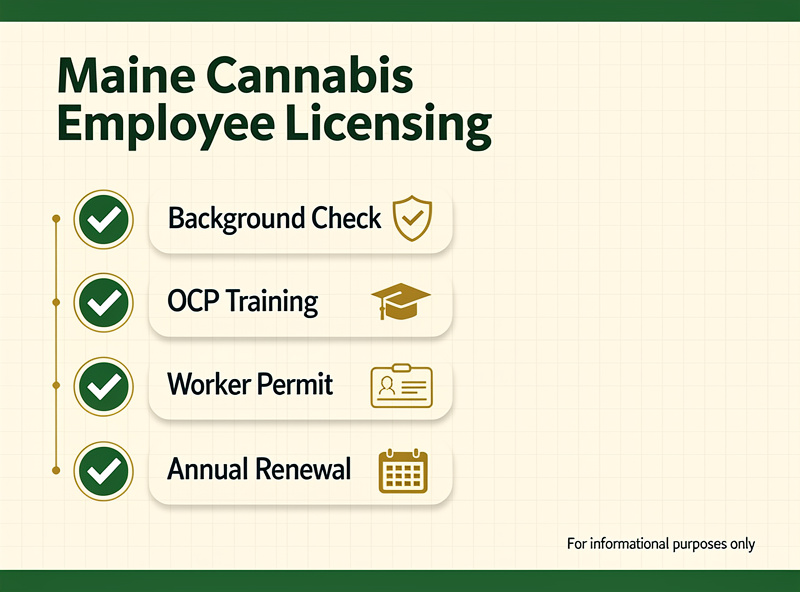
Submit the OCP worker permit application online. Pay the $50 application fee. Complete the background check (state and federal). Wait 2-4 weeks for processing. Receive your worker permit card.
The OCP processes approximately 200-300 worker permit applications per month. Incomplete applications are the most common cause of delays. Double-check every field before submitting.
Certain felony convictions within the past 10 years related to controlled substances will disqualify an applicant. OCP reviews each case individually. A past marijuana conviction does not automatically disqualify you.
Background Check Requirements
OCP runs both state and federal criminal background checks. Maine's approach to cannabis-related offenses is more nuanced than some states. A prior marijuana possession conviction does not automatically block employment in the cannabis industry. OCP reviews each application individually.
The background check process typically takes 2-4 weeks after fingerprints are submitted. Plan accordingly when building your hiring timeline. Many dispensaries run background checks on candidates before extending has to avoid delays.
Certain convictions disqualify applicants:
- Violent felonies
- Drug trafficking convictions
- Fraud-related crimes
- Crimes involving dishonesty or theft
OCP reviews each application individually. A past conviction does not automatically disqualify you. OCP looks at the nature of the offense. They also consider how long ago it occurred and other factors.
Positions and Permit Types
| Position | Permit Required | Notes |
|---|---|---|
| General Manager | Yes | May need additional endorsement |
| Budtender | Yes | Standard worker permit |
| Security | Yes | Standard worker permit |
| Inventory Staff | Yes | Standard worker permit |
| Delivery Driver | Yes | Must have valid Maine driver's license |
| Cleaning Staff | Yes | Standard worker permit |
Training Requirements
New hires must complete OCP's Responsible Vendor training within 90 days of starting work. This training covers:
- Maine cannabis laws and rules
- ID verification procedures
- Sales limits and recordkeeping
- Workplace safety
- Customer interaction and conflict resolution
Training must be completed at an OCP-approved vendor. Keep certificates on file for each employee. Responsible Vendor training covers Maine-specific rules. This includes sales limits. The state caps purchases at 2.5 grams of concentrate or its flower equivalent per transaction. Employees must understand these limits and enforce them at the register.
The ID verification requirement is strict. Maine law requires staff to verify age for any customer purchasing cannabis products. Employees must check a valid government-issued ID for every customer, every time. This is one of the most cited compliance issues during OCP inspections.
Responsible Vendor Training
Maine requires Responsible Vendor training within 90 days of hire. The training covers ID verification, recognizing intoxication, understanding purchase limits, and reporting requirements.
Maine-approved Responsible Vendor training costs 50 dollars-100 dollars per employee. It takes 2-4 hours to complete online. Several providers offer Maine-specific courses.
Building Your Staffing Pipeline
Hiring for a Maine dispensary has specific challenges. The pool of experienced cannabis workers is limited. Many came from the medical program era. They have strong product knowledge. Others are new to the industry. They bring retail experience from adjacent states. Knowing where to find candidates helps.
Ahead of opening, start the permit process for your core team 4-6 weeks before you need them. Here is the sequence:
- Receive your facility license number
- Collect permit applications from all planned hires
- Submit applications and fingerprints
- Receive permit approvals
- Schedule Responsible Vendor training
- Complete all training within 90 days of hire
Record Keeping
Maintain files for every employee containing:
- Copy of submitted permit application
- Permit approval notice
- Training completion certificates
- Background check results (if you retain them)
- Performance reviews and discipline records
Keep these records for at least 5 years after an employee leaves. OCP inspections can happen years after an incident. An inspector may ask for a training certificate from 2024 in 2027. You must produce it.
Maine dispensaries also need to track permit renewals. Worker permits expire and need renewal. Mark expiration dates in your calendar 60 days ahead. It takes time to get renewed permits, and you cannot have employees working on expired permits.
Staffing Costs for Maine Dispensaries
Budget for staffing carefully. A typical Maine dispensary with 4-6 employees runs 180,000-280,000 dollars in annual payroll. This represents roughly 25-35% of total operating costs.
| Position | Hourly | Annual |
|---|---|---|
| Budtender | 40 dollars-18 dollars | - |
| Shift Lead | 40 dollars-22 dollars | - |
| Store Manager | - | 55,000 dollars-75,000 dollars |
| Compliance Manager | - | 50,000 dollars-65,000 dollars |
| Security Guard | 40 dollars-20 dollars | - |
Expect to pay slightly above retail average to attract experienced cannabis workers. Benefits packages matter. Maine minimum wage is 40 dollars-15 dollars per hour as of 2026.
Key Takeaways
- Every employee needs an OCP worker permit — no exceptions
- Submit permit applications 4-6 weeks before needed start date
- Background checks run state and federal criminal history
- Responsible Vendor training must complete within 90 days of hire
- Keep training records — OCP audits will ask for them
- Permits must be renewed periodically — track expiration dates
External Resources
This is for informational purposes only. Verify current requirements with Maine OCP before making staffing decisions.
Maine-Specific Hiring Tips for Cannabis Operations
Hiring for Maine cannabis dispensaries requires understanding the state's employment landscape and culture. Maine's workforce has specific characteristics that affect recruiting, retention, and management approaches for retail operations.
Maine's unemployment rate fluctuates but has historically run below the national average in Portland and Augusta while running higher in rural areas like Aroostook and Washington counties. This geographic variation means hiring strategies differ significantly between Portland and northern Maine markets. Operators in Bangor and Lewiston compete for a smaller local labor pool but may find workers more focused on job stability than those in saturated Portland job markets.
The Maine cannabis industry competes with healthcare, tourism, and maritime industries for workers. Healthcare facilities in Portland and Bangor offer benefits packages that cannabis operators cannot match. Maritime work in Downeast Maine draws workers who prefer outdoor physically demanding jobs. Adjust your compensation and culture to compete effectively in your specific market.
Second-home owners and seasonal residents affect workforce availability in coastal Maine towns. Bar Harbor, Kittery, and other tourist destinations see workforce populations swell in summer and shrink in winter. Operators in these markets should plan for seasonal hiring surges and implement retention strategies that keep key staff through the slower winter months.
Training Requirements for Maine Dispensary Employees
Maine OCP requires Responsible Vendor training for all employees within 90 days of hire. This training covers state regulations, compliance obligations, age verification, and responsible sales practices. The training must be completed before employees handle cannabis products or serve customers.
Manager training goes beyond basic employee requirements. Dispensary managers must understand OCP rules in detail, know how to handle compliance inspections, and be able to train new employees on regulatory requirements. Some operators send managers to additional cannabis compliance certification programs that build expertise beyond the minimum required training.
Document all training with sign-in sheets, completion certificates, and acknowledgment forms. OCP inspectors review training documentation during inspections. Incomplete or missing training records create compliance risk. Maintain training records for at least three years, matching the record retention period for other operational documentation.
Ongoing education keeps staff current as regulations change. Maine cannabis rules update periodically as OCP modifies guidance and the legislature passes new laws. Operators should conduct quarterly refresher training sessions that cover regulatory updates and reinforce compliance culture. These sessions also provide opportunities to review incident reports and address any operational issues.
HR Compliance for Maine Cannabis Employers
Maine cannabis employers must comply with both state employment law and OCP-specific regulations. The intersection of these frameworks creates compliance complexity that HR generalists may not understand without cannabis-specific experience.
Background check requirements under OCP extend beyond standard employment background checks. All worker permit applications require criminal background disclosure and FBI fingerprint-based checks. Certain disqualifying convictions prevent OCP permit issuance. Employers should run background checks on finalists before extending job offers to avoid hiring employees who cannot obtain work permits.
Worker classification matters for cannabis operations. The OCP distinguishes between employees who work at licensed facilities and contractors. Misclassifying employees as independent contractors to avoid payroll taxes or benefits creates legal exposure. Ensure your HR practices treat workers correctly under Maine employment law regardless of their willingness to accept contractor status.
Workplace safety requirements under Maine OSHA rules apply to cannabis facilities. Cultivation operations face specific safety concerns around chemical handling, ventilation, and repetitive motion injuries. Extraction facilities require additional safety protocols around pressurized equipment and flammable solvents. Document your safety practices and conduct regular safety training to maintain compliance and reduce workers compensation exposure.