Cannabis Delivery Rules in Maine
What Maine dispensaries need to know about delivery
Delivery at a Glance
| Delivery License | Separate courier license required |
| Delivery Area | Within Maine only |
| Age Verification | Required at delivery address |
| Driver Authorization | OCP-issued employee badge |
| Vehicle Tracking | GPS required |
| Vehicle Cost | $25,000-50,000 |
Can Maine Dispensaries Deliver?
Yes. Maine allows licensed dispensaries to deliver cannabis products directly to customers. You need a courier license from the OCP. This is separate from your retail license.
Delivery expands your market. You reach customers who cannot visit your store. This includes people with mobility issues, those in areas with limited dispensary access, and those who prefer doorstep convenience.
License Requirements
The OCP issues courier licenses under M.R.S. Title 28-B, Section 204. Your delivery operation must hold this license. Each driver also needs an employee authorization badge from the OCP.
The application requires your delivery vehicle details, security plan, and operational procedures. The OCP reviews everything before issuing the courier license. Courier licenses in Maine are separate from your retail license — you cannot make deliveries under a dispensary license without the courier endorsement. If you operate a delivery service, the OCP may inspect your vehicles as part of routine compliance audits.
Customer Restrictions
You can only deliver to addresses within Maine. Deliveries must go to the customer named on the order. No drops to third parties. This means a customer cannot ask you to leave the package with a roommate or neighbor. The person who placed the order must be the one to receive it in person.
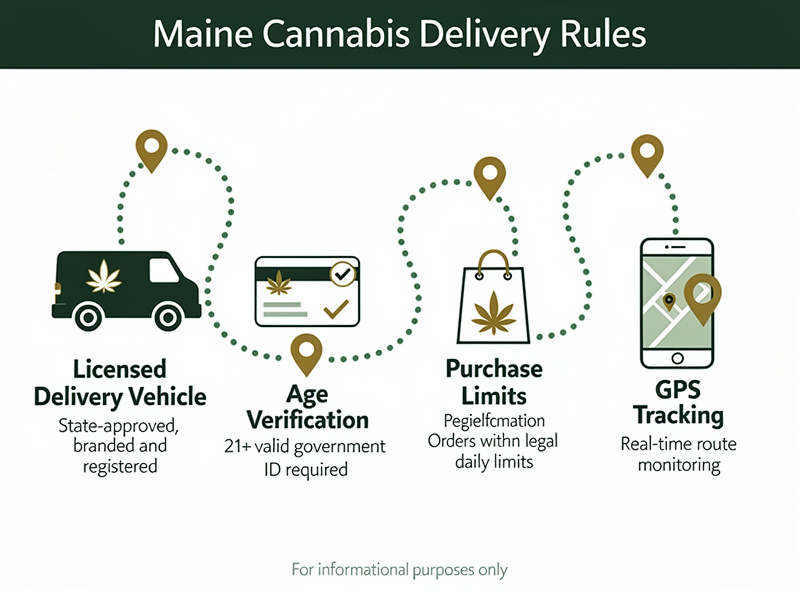
Each customer must be 21 or older. Your driver verifies ID at the delivery address. This cannot be skipped. The customer must be present and show valid ID.
You cannot deliver to public spaces. No hotel lobbies. No workplace common areas. The delivery must go to a private residence or another address you have verified.
What You Can Deliver
Your delivery inventory comes from your licensed dispensary. Products must be tracked in Metrc. When you pull products for delivery, you log them as a delivery sale in the system.
Delivery quantities have limits. Maine law caps how much a single delivery can include. Check current OCP rules for exact limits. These change as regulations evolve. All delivered products must be tracked from your licensed dispensary in Metrc — you cannot pick up products from other dispensaries to fulfill delivery orders.
Vehicle Requirements
Your delivery vehicle must be properly insured. It needs secure product storage. The OCP requires locked containers that keep products out of sight.
GPS tracking is required. The OCP wants to know where deliveries go. Some operators add extra security cameras in delivery vehicles. This is not required but recommended. Vehicles must have GPS tracking active during all delivery runs. Some operators install secondary locked compartments specifically for cannabis product storage — this separates the product from personal items and demonstrates compliance during any traffic stop or inspection.
Two-person deliveries are a good practice. One driver, one person who stays with the product. This reduces theft risk and provides witness coverage for ID verification.
Delivery Logs
You must document every delivery. Logs include the customer name, delivery address, time, driver, and products delivered. These records must be available for OCP inspection.
Metrc captures delivery data automatically if your POS integrates with it. If not, maintain manual logs. Incomplete records create compliance risk.
Delivery Market Opportunity in Maine
Maine's delivery market is underserved. As of early 2026, fewer than 15 of the state's 240+ licensed dispensaries offer delivery services. Portland has 3-4 delivery-capable dispensaries. Most rural areas have zero delivery options.
import Callout from '@network/ui/Callout'; export default Callout;This creates a clear opportunity for operators willing to invest in the courier license and vehicle infrastructure. Customer demand for delivery exists. The supply of delivery-capable dispensaries has not caught up.
Courier License Application Process
The courier license is separate from and also your retail license. You cannot deliver under a standard dispensary license. Here are the steps to obtain your courier endorsement.
- Submit OCP courier license application with the $500 fee
- Provide vehicle details and security plan documentation
- Complete background checks for all delivery personnel
- Wait through OCP review period (typically 30-60 days)
- Receive courier license endorsement on your existing license
The application requires detailed vehicle information. You must describe the make, model, and year of each delivery vehicle. Security plans need to cover product storage, GPS tracking, and driver identification protocols.
Background checks apply to every employee who will handle deliveries. The OCP looks at criminal history and may deny authorization to individuals with certain convictions. Plan this into your hiring timeline.
Insurance Requirements for Delivery
Cannabis delivery requires specialized insurance coverage. Most standard insurers will not cover cannabis delivery operations. You need providers who work specifically with cannabis businesses.
| Insurance Type | Annual Cost |
|---|---|
| Commercial auto insurance | $3,000-8,000 |
| Product liability insurance | $2,000-5,000 |
| General liability insurance | $1,500-4,000 |
| Cargo insurance | $1,000-3,000 |
Commercial auto insurance covers your delivery vehicles. Standard personal auto policies exclude cannabis business use. Your provider must understand the cargo you carry.
Product liability protects you if a customer claims your product caused harm. This is separate from general liability which covers slips and falls at your premises.
Cargo insurance covers the product while in transit. A robbery or accident could destroy thousands of dollars in inventory. Cargo coverage ensures you do not absorb that loss.
Delivery Costs
| Item | Cost |
|---|---|
| Delivery vehicle | $25,000-50,000 |
| Security equipment | $5,000-15,000 |
| GPS and tracking | $2,000-5,000 |
| Courier license | $1,000-3,000 |
| Insurance (annual) | $5,000-10,000 |
Monthly operating costs include fuel, vehicle maintenance, driver wages, and insurance. Budget realistically before launching delivery service.
Common Mistakes
OCP compliance audits for delivery operations have increased as the adult-use market matures. Officers look for proper ID verification, accurate delivery logs, and secured product storage. Being able to demonstrate a consistent verification process protects your license during inspections.
- Skipping ID verification. Drivers sometimes skip this under time pressure. Do not. OCP undercover operations test this.
- Poor delivery logs. If Metrc does not capture delivery data, maintain manual records. Missing logs are a violation.
- Unsecured vehicles. Products left visible in an unlocked vehicle create liability. Secure containers and locked vehicles always.
- Delivering to wrong addresses. Verify every address before dispatch. Deliveries to unverified locations risk your license.
Key Takeaways
- Courier license required from OCP
- Deliver only to verified Maine addresses
- Verify customer age at every delivery
- Log every delivery in Metrc or manual records
- Secure vehicles with locked product storage
- Two-person deliveries recommended
External Resources
Maine-Specific Delivery Rules
Maine's cannabis delivery regulations operate under OCP Chapter 10 with specific requirements that differ from many other states. Understanding these rules before applying for a delivery endorsement prevents costly compliance mistakes.
Delivery endorsement requires separate licensing beyond your dispensary license. The OCP issues courier endorsements that authorize retail licensees to transport cannabis products to customers. This endorsement appears on your existing license with a delivery authorization notation rather than as a separate license number.
Municipal restrictions affect delivery operations in some Maine towns. While your dispensary license permits delivery statewide, some municipalities have enacted local ordinances restricting delivery vehicle parking or pickup in certain zones. Portland requires delivery vehicles to park in designated areas and prohibits curbside handoff in some districts. Verify local rules in your primary service area before establishing delivery routes.
Customer age verification happens at the delivery address, not at the dispensary. Drivers must verify that recipients are 21 or older using government-issued photo identification before handing over products. This differs from in-store sales where age verification happens at the door. Drivers cannot leave products on doorsteps or with third parties.
Route Planning for Maine Cannabis Delivery
Effective route planning reduces fuel costs, limits vehicle wear, and ensures timely deliveries that satisfy customers. Maine's geography makes route planning more complex than in more compact states.
Northern Maine delivery routes require special planning. Customers in Aroostook County may be hours away from your dispensary. Serving these customers profitably requires either accepting longer delivery windows or focusing on high-value orders that justify extended trips. Most operators limit northern delivery to orders exceeding $200 in product value to justify the travel time.
Island deliveries require ferry or water taxi coordination. Islesboro, Vinalhaven, and other island communities off the Maine coast require additional logistics. Some operators decline island deliveries due to weather dependencies and added cost. Others include delivery surcharges or minimum order requirements for island service.
Seasonal traffic patterns affect delivery timing. Summer construction on I-95 creates delays that extend delivery times. Winter weather in the mountains requires vehicle preparation and may limit access to outlying areas. Building buffer time into delivery windows accounts for these seasonal factors.
Vehicle Requirements for Maine Cannabis Delivery
OCP vehicle requirements for cannabis delivery include GPS tracking, secure product storage, and insurance documentation. The vehicle must be registered to the licensed dispensary or under a delivery contract with the licensee.
Secure storage means the product cannot be visible from outside the vehicle. Standard trunk space qualifies if the rear cargo area is separated from the passenger compartment. Vehicles with rear windows or open cargo areas require additional security measures such as locking cargo boxes or vehicle wraps that obscure interior contents.
GPS tracking must provide real-time location data to OCP upon request. Some operators use dedicated tracking devices that broadcast continuously. Others use smartphone apps that provide location sharing through the delivery management software. Regardless of method, records must show vehicle location at each delivery stop.
Vehicle costs range from $25,000-$50,000 for compliant delivery vehicles with security features. Used vehicles with low mileage can work if they meet security and GPS requirements. Many operators start with leased vehicles to limit capital exposure while testing delivery demand.
Delivery regulations change. Verify current rules with the Maine OCP before starting delivery operations.