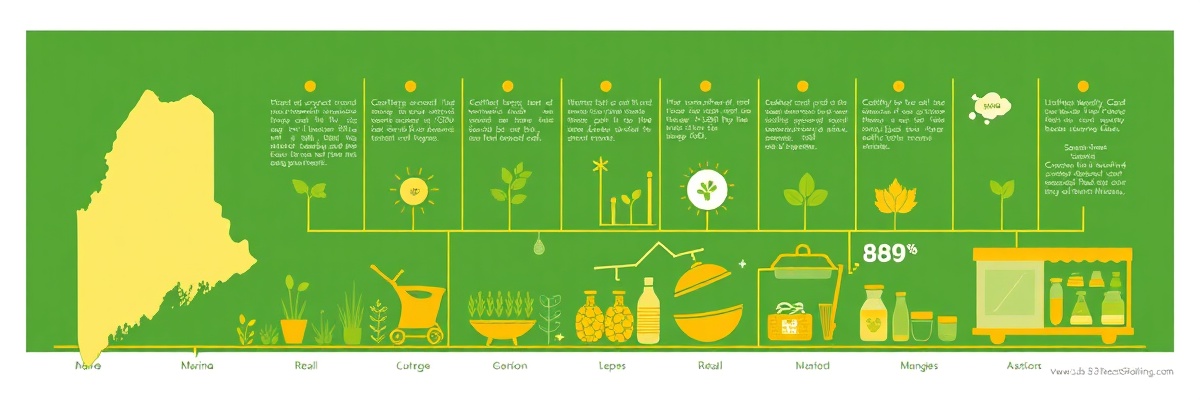
Maine Cannabis Vertical Integration
The complete guide to controlling cultivation, manufacturing, and retail under one company in Maine
Overview
Vertical integration in Maine's cannabis industry means a single company controls multiple stages of the supply chain — from seed to sale. Under Maine law (28-B M.R.S. §205(2)), operators may apply for and hold multiple license types simultaneously, making it possible to cultivate flower, manufacture concentrates and edibles, and sell directly to consumers through branded retail storefronts — all under one corporate umbrella. This is not merely a regulatory convenience; it is a strategic advantage that fundamentally reshapes unit economics.
Maine's adult-use cannabis market generated approximately $244 million in revenue in 2024, while the medical program — one of the oldest and most solid in the nation — added roughly $280 million in annual sales. In a market this size, the margin differential between vertically integrated and single-license operators is staggering: VI operators routinely capture 55–65% blended gross margins, compared to 30–40% for businesses that buy wholesale flower or sell only third-party products. That 15–25 percentage point spread translates to hundreds of thousands of dollars in additional annual profit per location.
The decision to pursue vertical integration in Maine is not taken lightly. It requires significant capital — typically $2 million to $6 million or more — sophisticated compliance infrastructure, and management bandwidth across cultivation science, extraction chemistry, retail operations, and multi-layered regulatory reporting. But for operators who execute well, vertical integration has supply chain resilience, brand differentiation, pricing power, and the most favorable position available under IRC Section 280E's punitive tax regime. This guide breaks down every dimension of the decision: legal framework, license types, economics, tax strategy, real operator profiles, municipal considerations, risks, and a step-by-step plan to launch.
Vertical Integration at a Glance
| Legal Status | Permitted (28-B M.R.S. §205(2)) |
| License Types Available | Cultivation, Manufacturing, Retail |
| Max Cultivation Licenses | 3 per entity (30,000 sq ft canopy) |
| Startup Capital (Full VI) | $2M–$6M+ |
| Blended Gross Margin | 55–65% |
| Break-Even Timeline | 4–7 years |
| Monthly Operating Burn | $250K–$500K+ |
| Testing Facility | Must be separated (no cross-ownership) |
Maine's Permissive Framework
What Is Vertical Integration in Maine Cannabis?
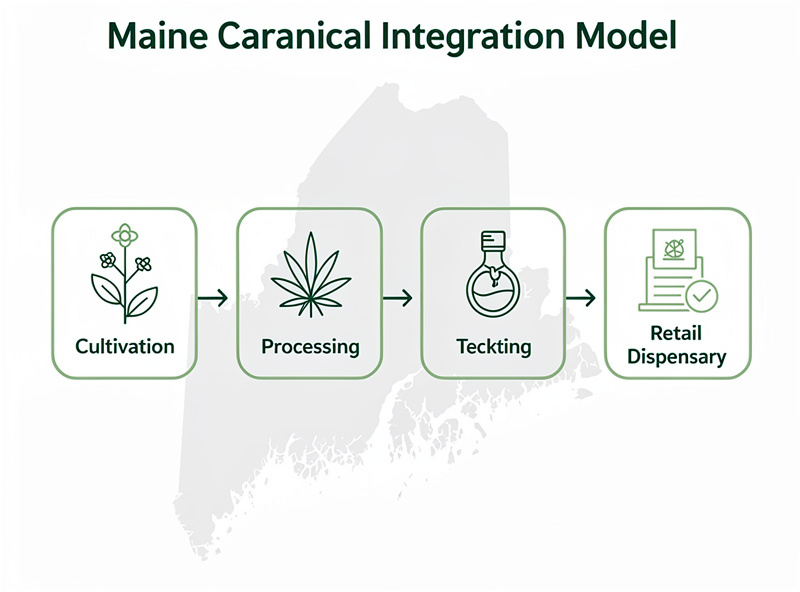
Vertical integration is a business structure in which a single entity controls multiple consecutive stages of production and distribution within the same industry. In the cannabis context, this means one company grows the plant (cultivation), processes it into smokable flower, concentrates, edibles, and topicals (manufacturing), and sells those products directly to adult-use or medical consumers through its own retail storefronts (dispensary). The alternative — a single-license model — means a company participates in only one of those stages, buying inputs from or selling outputs to other licensed operators.
Maine's legal framework for vertical integration is codified in 28-B M.R.S. §205(2), which states plainly: "An applicant may apply for and be granted multiple licenses of any license type." This language is deliberately permissive. Unlike states such as Illinois or Pennsylvania, which have historically required vertical integration as a condition of licensure, or states like California, which impose restrictions on cross-license ownership, Maine leaves the decision entirely to the operator. You can hold a single retail license and buy all your product from wholesalers. You can hold a cultivation license and sell exclusively to manufacturers. Or you can hold all three and operate a fully integrated seed-to-sale enterprise.
There is one critical firewall: testing facilities. Maine law requires that cannabis testing laboratories operate independently from cultivation, manufacturing, and retail operations. No entity that holds a cultivation, manufacturing, or retail license may hold an ownership interest in a testing facility, and vice versa. This separation is designed to prevent conflicts of interest in product safety testing — a consumer protection measure that all vertically integrated operators must respect in their corporate structuring.
The practical implication of Maine's permissive framework is that vertical integration is a strategic choice driven by economics, brand vision, and operational capability — not a regulatory requirement or prohibition. Operators who choose VI do so because the margin expansion, supply chain control, and tax advantages outweigh the additional capital requirements and compliance complexity. Operators who choose a single-license model do so because they want to focus on one core competency, reduce startup risk, or enter the market faster with less capital.
Maine's License Types — The Building Blocks
Understanding Maine's license architecture is essential to designing a vertical integration strategy. The Office of Cannabis Policy (OCP), which operates under the Department of Administrative and Financial Services, issues and regulates all adult-use and medical cannabis licenses in the state. Each license type has distinct requirements, fee schedules, and operational parameters.
Cultivation licenses are tiered by canopy size — the total square footage of flowering canopy. Tier 1 is the smallest, allowing up to 500 square feet or 30 plants, with annual fees ranging from $250 to $500. Tier 2 permits up to 2,000 square feet at $1,500 to $3,000 annually. Tier 3 covers up to 7,000 square feet for $5,000 to $10,000 per year. Tier 4, the largest commercial tier, allows up to 20,000 square feet with annual fees of $15,000 to $30,000. A single entity may hold up to three cultivation licenses, capping total canopy at 30,000 square feet. This cap is designed to prevent corporate monopolization while still allowing meaningful commercial scale. For the full cultivation licensing walkthrough — tier selection, canopy limits, application steps, and costs — see the Maine Cannabis Cultivation License guide.
Products Manufacturing licenses authorize the extraction, infusion, and packaging of cannabis into concentrates, edibles, tinctures, topicals, and other non-smokable products. The annual fee is $2,500, and production capacity is regulated by volume rather than square footage. Manufacturing licenses cover a wide range of activities — from small-batch edible kitchens to large-scale hydrocarbon extraction labs — and require specific equipment, ventilation, and safety protocols depending on the extraction methods used.
Cannabis Store licenses authorize retail sales to adult-use consumers (age 21+) and, if the operator also holds a medical endorsement, to registered medical patients. The annual fee is $2,500. Retail operations must comply with point-of-sale tracking requirements, purchase limits, security standards, and local zoning ordinances. There is no statutory cap on the number of retail licenses a single entity may hold, though each location requires separate municipal approval and state licensure.
Testing Facility licenses authorize laboratory analysis of cannabis products for potency, contaminants, and compliance. The annual fee ranges from $1,500 to $3,000. Critically, testing facilities must maintain complete independence from all other license types. No person or entity with a financial interest in a cultivation, manufacturing, or retail operation may hold any interest in a testing facility. This firewall is non-negotiable and is enforced through OCP's ownership disclosure requirements.
| License Type | Function | Canopy/Production | Annual Fee Range |
|---|---|---|---|
| Cultivation Tier 1 | Small-scale growing | 500 sq ft / 30 plants | $250–$500 |
| Cultivation Tier 2 | Small commercial | 2,000 sq ft | $1,500–$3,000 |
| Cultivation Tier 3 | Mid-scale | 7,000 sq ft | $5,000–$10,000 |
| Cultivation Tier 4 | Large commercial | 20,000 sq ft | $15,000–$30,000 |
| Products Manufacturing | Extraction, edibles | By volume | $2,500 |
| Cannabis Store | Retail sales | N/A | $2,500 |
| Testing Facility | Lab certification | N/A | $1,500–$3,000 |
The same entity can hold multiple licenses across these categories. A vertically integrated operator in Maine might hold, for example, two Tier 4 cultivation licenses (40,000 sq ft — though note the 30,000 sq ft practical cap), one products manufacturing license, and three cannabis store licenses. There is no cap on manufacturing or retail licenses. The only restriction is the three-license limit on cultivation and the testing facility firewall. This structure gives operators enormous flexibility to scale their operations in alignment with market demand and capital availability.
Vertical Integration vs. Single-License — Which Model Wins?
The choice between vertical integration and a single-license model is fundamentally a trade-off between margin and complexity. Vertically integrated operators capture value at every stage of the supply chain. Instead of paying wholesale prices for flower and surrendering a margin to a cultivator, a VI operator grows its own product at cost and retains the full retail margin. Instead of paying a manufacturer to produce edibles, a VI operator produces in-house and captures both the manufacturing margin and the retail markup. The result is a blended gross margin of 55–65%, compared to 40–50% for a retailer that purchases all inventory from third-party suppliers.
But that margin advantage comes at a steep price — literally. A fully vertically integrated operation in Maine typically requires $2 million to $6 million or more in startup capital, encompassing facility acquisition or construction, cultivation equipment (lighting, HVAC, irrigation, environmental controls), extraction and manufacturing equipment, dispensary build-out, security infrastructure, and at least 12 months of working capital. A single-license retail operation, by contrast, can launch with $300,000 to $1.5 million, depending on location, build-out scope, and initial inventory purchases.
Operational complexity scales accordingly. A VI operator must manage cultivation schedules, harvest cycles, extraction protocols, product formulation, retail merchandising, and multi-layered compliance reporting across three distinct regulatory frameworks. A single-license retailer focuses on one domain: buying quality product, managing inventory, and serving customers. The compliance burden for a VI operator is correspondingly heavier — three times the license renewals, three times the inspection readiness, three times the Metrc reporting obligations.
Risk profiles differ as well. A VI operator is exposed to risks at every stage: crop failure, extraction equipment malfunction, retail theft or compliance violations. A single-license operator's primary risks are supply chain disruption (if a wholesaler fails to deliver) and retail-level compliance issues. However, the VI operator also has more tools to mitigate risk — if retail demand softens, they can redirect product to wholesale channels; if a cultivation batch fails, they can supplement with purchased flower. A single-license operator has fewer internal levers to pull when problems arise.
Time to revenue is another differentiator. A retail-only operation can typically open within 6–12 months of beginning the licensing process. A fully VI operation requires 12–18 months or more, as cultivation facilities must be built, planted, grown through full vegetative and flowering cycles, harvested, processed, and tested before any product is available for retail sale. The first harvest from a new cultivation facility typically takes 4–6 months from plant start, adding significant time before the first retail dollar is earned.
| Factor | Vertically Integrated | Single-License (Retail) |
|---|---|---|
| Startup Capital | $2M–$6M+ | $300K–$1.5M |
| Gross Margin | 55–65% | 40–50% |
| Time to Revenue | 12–18 months | 6–12 months |
| Compliance Complexity | High (3+ licenses) | Moderate (1 license) |
| Supply Chain Control | Full | Dependent on wholesalers |
| Break-Even | 4–7 years | 2–4 years |
| Regulatory Risk | Higher (more touchpoints) | Lower |
Municipal Warning
The Economics — Real Costs of Going Vertical
The economics of vertical integration in Maine's cannabis market are compelling but capital-intensive. Understanding the real costs — not just the license fees, but the facility build-out, equipment, staffing, and working capital required — is essential to making an informed decision. The numbers below reflect current market conditions as of 2026 and are based on data from actual Maine operators, industry consultants, and commercial real estate transactions.
Licensing and legal costs for a VI operator running all three primary licenses (cultivation, manufacturing, retail) typically range from $15,000 to $30,000. This includes state application and licensing fees, municipal application fees, legal counsel for application preparation and corporate structuring, and consulting fees for facility design and compliance planning. A single-license retail operator spends $5,000 to $10,000 on the same categories, reduced scope.
The cultivation facility is the single largest capital expenditure. A commercial-scale indoor grow facility in Maine — including building acquisition or leasehold improvements, HVAC systems, lighting (LED or HPS), irrigation, environmental controls, security infrastructure, and initial genetics — runs $500,000 to $2 million or more, depending on canopy size, facility condition, and technology choices. Outdoor or greenhouse cultivation can reduce these costs significantly but introduces climate risk and may limit year-round production capacity.
Manufacturing equipment represents the second major capital outlay. A basic edible production kitchen may cost $200,000 to $400,000 to equip. A hydrocarbon or ethanol extraction lab with closed-loop systems, vacuum ovens, winterization equipment, and post-processing tools runs $400,000 to $800,000 or more. The scope of manufacturing operations — and therefore the equipment investment — depends entirely on the product mix the operator intends to produce in-house.
Dispensary build-out costs are similar for VI and single-license operators: $300,000 to $700,000, covering leasehold improvements, security systems, point-of-sale technology, display fixtures, signage, and initial inventory. For a VI operator, initial inventory costs are lower (since much of the product is grown and manufactured in-house), but the build-out itself is identical in scope.
Security systems for a VI operation are more extensive, as multiple facilities must each meet OCP security requirements: 24/7 video surveillance, access control systems, alarm systems, and secure storage. Total security investment across cultivation, manufacturing, and retail facilities runs $50,000 to $100,000, compared to $25,000 to $50,000 for a single retail location.
Working capital is the most underestimated cost in cannabis business planning. A VI operator should budget $400,000 to $1 million for 12 months of operating expenses, covering payroll, utilities, insurance, compliance costs, marketing, and contingency reserves. A retail-only operator needs $150,000 to $300,000 for the same period.
| Cost Category | VI (All 3 Licenses) | Retail Only |
|---|---|---|
| Licensing & Legal | $15K–$30K | $5K–$10K |
| Cultivation Facility | $500K–$2M | $0 |
| Manufacturing Equipment | $200K–$800K | $0 |
| Dispensary Build-Out | $300K–$700K | $300K–$700K |
| Security Systems | $50K–$100K | $25K–$50K |
| Working Capital (12 mo) | $400K–$1M | $150K–$300K |
| Total Range | $1.5M–$5M+ | $480K–$1.1M |
Phased Approach
The 280E Tax Advantage
IRC Section 280E is the single most consequential tax provision affecting cannabis businesses in the United States. It prohibits any business that traffics in Schedule I or II controlled substances from deducting ordinary business expenses — rent, payroll, marketing, utilities — from federal taxable income. The one exception is Cost of Goods Sold (COGS): the direct costs of producing inventory. For cannabis operators, the strategic allocation of costs between COGS and non-deductible operating expenses is the difference between profitability and catastrophic tax liability.
Vertical integration provides a structural advantage under 280E because cultivation and manufacturing operations have significantly higher COGS ratios than retail. A cultivation operation can classify 70–85% of its operating costs as COGS — including grow media, nutrients, lighting, HVAC, labor directly tied to cultivation, and facility costs allocable to the production area. A manufacturing operation can classify 55–70% of its costs as COGS, covering extraction solvents, packaging materials, formulation labor, and production equipment. A retail operation, by contrast, can only classify 20–40% of its costs as COGS — essentially the wholesale cost of purchased inventory.
By operating cultivation, manufacturing, and retail under one corporate structure, a VI operator can allocate a much larger percentage of its total costs to COGS-eligible activities. Instead of paying a wholesale markup to a third-party cultivator (which embeds the cultivator's profit margin into the retailer's COGS), the VI operator grows at cost and captures the full COGS deduction on its own production expenses. The result is a lower effective tax rate and higher after-tax profitability.
| Entity Type | COGS Allocation | 280E Impact |
|---|---|---|
| Cultivation | 70–85% of operating costs | Least impacted |
| Manufacturing | 55–70% of operating costs | Moderate impact |
| Distribution | 40–60% of operating costs | Higher impact |
| Retail | 20–40% of operating costs | Most restricted |
Transfer pricing between the cultivation, manufacturing, and retail divisions of a VI operator is a critical consideration. The IRS requires that intercompany transactions be conducted at arm's length — meaning the price at which the cultivation division sells flower to the manufacturing division must reflect fair market value, not an artificially low price designed to shift profits into the COGS-heavy cultivation entity. VI operators must document their transfer pricing policies and be prepared to defend them in the event of an audit. Working with a cannabis-specialized CPA is essential.
At the state level, Maine has decoupled from certain federal tax provisions, offering some relief from 280E's impact on state income tax liability. Maine allows cannabis businesses to deduct ordinary business expenses on their state tax returns, even though those same expenses are non-deductible federally. This decoupling reduces the overall tax burden for Maine operators, though the federal 280E liability remains the dominant tax concern. For a deeper analysis of 280E strategy specific to Maine, see our Maine Cannabis Taxation and 280E Guide.
Maine VI Operators in Practice
Vertical integration is not a theoretical concept in Maine — it is the operating model of some of the state's most prominent cannabis companies. Examining how these operators have structured their businesses provides practical insight into the opportunities and challenges of the VI model.
Paul's Boutique in Windham is one of Maine's most recognizable vertically integrated operators. The company operates a cultivation facility, manufacturing operation, and retail dispensary under one brand, controlling the full supply chain from cultivation to consumer. Paul's Boutique has built its reputation on product quality and brand consistency — advantages that are easier to achieve when every stage of production is managed in-house. The company's retail location has its own branded products alongside select third-party offerings, giving customers a curated experience while maintaining the margin benefits of in-house production.
Sweet Dirt, founded by Ali Wrye, has grown from a small cultivation operation into a multi-location vertically integrated brand with retail stores across southern Maine. Sweet Dirt's approach emphasizes organic cultivation practices, community engagement, and a distinctive brand identity rooted in Maine's agricultural heritage. The company's VI structure allows it to maintain quality control across its product line while scaling retail presence in high-traffic markets. Sweet Dirt has been vocal about the importance of Maine's permissive licensing framework in enabling its growth trajectory.
Full Bloom Cannabis operates as a vertically integrated cultivator, manufacturer, and retailer with a focus on sun-grown and greenhouse cultivation methods that reduce energy costs and environmental impact. The company's VI model allows it to use its cultivation expertise into branded retail experiences, offering consumers products grown and processed under the company's direct supervision. Full Bloom's approach demonstrates that VI is not limited to indoor, energy-intensive cultivation — sustainable growing methods can be integrated into a VI model effectively.
ORIGINs Cannabis has built a vertically integrated operation emphasizing product innovation and brand differentiation. The company's manufacturing capabilities enable it to develop proprietary product formulations — from specific concentrate profiles to custom edible recipes — that are available exclusively at its retail locations. This exclusivity drives customer loyalty and allows ORIGINs to command high-quality pricing, further enhancing the margin advantages of vertical integration.
"Maine's licensing framework gives us the freedom to build the business model that makes sense for our market, not the one a regulator dictates. Vertical integration lets us control quality from seed to shelf, and that's what our customers expect from us." — Ali Wrye, Founder of Sweet Dirt, as quoted in industry publications discussing Maine's cannabis regulatory environment.
The Municipal Landscape — Where Can You Go Vertical?
Maine's cannabis regulatory framework delegates significant authority to municipalities. Under state law, no cannabis business may operate within a municipality that has not affirmatively opted in to allow that specific license type. This opt-in system creates a patchwork landscape in which one town may permit retail dispensaries but prohibit cultivation, another may allow cultivation and manufacturing but not retail, and a third may permit all license types. For a vertically integrated operator, this municipal fragmentation is one of the most significant strategic challenges.
As of 2026, approximately 200 Maine municipalities have opted in to allow some form of cannabis business. However, the number of towns that permit all three primary license types — cultivation, manufacturing, and retail — is substantially smaller. Many towns that initially voted to allow dispensaries have not extended that authorization to cultivation or manufacturing facilities, often due to concerns about odor, traffic, environmental impact, or community character. This means that a VI operator seeking to house all three operations within a single municipality may find very limited options.
The practical solution for many VI operators is a multi-town strategy: locating the cultivation facility in a municipality with favorable agricultural zoning and cultivation authorization, the manufacturing operation in an industrial zone that permits processing, and the retail dispensary in a high-traffic commercial area with retail authorization. This approach is entirely legal under Maine law — there is no requirement that all licenses held by a single entity be located within the same municipality. However, it adds logistical complexity, including transportation compliance between facilities, multi-municipality relationship management, and potentially higher operational costs.
Municipal fees also vary widely. Some towns charge nominal application fees of a few hundred dollars; others charge thousands. Some impose annual licensing fees on top of state fees; others do not. A few municipalities have enacted local taxes on cannabis sales also the state excise tax. Before committing to a location, VI operators should conduct thorough due diligence on municipal ordinances, fee schedules, zoning requirements, and the political climate surrounding cannabis business in each target town.
Verify Current Ordinances
Risks and Challenges
Vertical integration has compelling advantages, but it is not without substantial risks. Understanding these risks is essential to making an informed decision and building a resilient operation.
Capital risk is the most immediate concern. A VI operator commits $2 million to $6 million or more before generating meaningful revenue. If market conditions shift — if retail prices decline faster than projected, if cultivation yields underperform, or if manufacturing equipment fails to produce at expected capacity — the operator may face cash flow shortfalls that threaten the entire enterprise. Unlike a single-license operator who can pivot more easily, a VI operator has significant fixed costs across multiple facilities that cannot be quickly reduced.
Compliance risk is amplified in a VI structure because every license held by the operator is a potential point of regulatory violation. A compliance issue at the cultivation facility — a pesticide violation, a Metrc reporting discrepancy, a security breach — can trigger enforcement action that affects the operator's manufacturing and retail licenses as well. The OCP evaluates license holders holistically, and a pattern of violations across multiple licenses can lead to suspension or revocation of the entire operation. VI operators must invest in solid compliance infrastructure, including dedicated compliance officers, internal audit processes, and staff training programs.
Operational risk stems from the breadth of expertise required to run a VI operation successfully. Cultivation requires horticultural knowledge, environmental management, and harvest planning. Manufacturing requires chemistry expertise, equipment maintenance, and product formulation skills. Retail requires merchandising, customer service, inventory management, and point-of-sale compliance. Finding and retaining talent across all three domains is challenging, and management bandwidth is finite. Many VI operators struggle with the transition from being excellent at one thing to being competent at three.
Exit complexity is a less obvious but significant risk. Selling a vertically integrated cannabis business is more complex than selling a single-license operation. The buyer must be qualified to hold all license types, the valuation must account for multiple asset classes, and the transfer process requires OCP approval for each license. This complexity can limit the pool of potential buyers and extend the timeline for a sale, reducing the operator's strategic flexibility.
"Vertical integration is a double-edged sword. When it works, the margins and control are. When it doesn't, you're exposed on every front simultaneously. The operators who succeed are the ones who respect the complexity and invest in the infrastructure to manage it." — Cannabis industry consultant specializing in Maine market operations.
The Craft Cannabis Counter-Argument
Not everyone believes vertical integration is the optimal model for Maine's cannabis market. The state's unique history — particularly its medical cannabis caregiver program, one of the oldest and most successful in the nation — has created a ecosystem of small-scale cultivators, artisanal manufacturers, and independent retailers who argue that craft cannabis, not corporate consolidation, is what makes Maine's market distinctive.
Maine's medical cannabis program, established in 1999, operates through a caregiver model in which registered caregivers cultivate cannabis for registered patients. As of 2026, there are approximately 1,724 registered caregivers serving tens of thousands of patients across the state. The medical program generates roughly $280 million in annual revenue — comparable to or exceeding the adult-use market — and employs over 5,000 Mainers across cultivation, processing, retail, and ancillary services. Many of these operations are small, family-run businesses that have built deep community relationships and reputations for quality over decades.
The craft cannabis argument against vertical integration centers on several points. First, that large-scale VI operators can undercut small cultivators on price, driving independent growers out of the market and reducing product diversity. Second, that corporate consolidation reduces the authentic, community-rooted character that has defined Maine's cannabis culture. Third, that the caregiver model — which is inherently decentralized and small-scale — is better aligned with Maine's agricultural traditions and values than the corporate VI model.
These arguments have played out in the Maine Legislature. Among other bills, LD 104 (132nd Legislature, 2025-26) — "An Act to Protect the Health of Medical Cannabis Patients and Streamline the Mandatory Testing of Cannabis" — and LD 1847 (131st, 2023-24) — the medical Metrc tracking bill — have sought to balance the interests of small-scale operators with the realities of a maturing market. Some proposals have called for cultivation license caps, preferential treatment for caregiver-converted businesses, or restrictions on the number of licenses a single entity can hold. While Maine's current framework remains permissive, the legislative debate reflects an ongoing tension between two visions for the state's cannabis future: one that embraces scale and integration, and one that prioritizes craft and community.
For operators considering vertical integration, the craft cannabis counter-argument is worth understanding not because it will necessarily change the regulatory landscape, but because it shapes consumer sentiment. Many Maine cannabis consumers actively seek out craft, small-batch, and locally grown products. A VI operator that can authentically communicate its commitment to quality, sustainability, and community — rather than appearing as a faceless corporate entity — can capture both the margin advantages of integration and the brand loyalty associated with craft cannabis.
Step-by-Step Path to Vertical Integration
Launching a vertically integrated cannabis operation in Maine is a multi-stage process that requires careful planning, coordination across multiple regulatory bodies, and disciplined project management. The following seven-step plan reflects the experience of successful VI operators in the state.
- Business Entity Formation — Establish a Maine business entity (typically an LLC or corporation) with a clear ownership structure. All individuals with financial interest in the entity must be disclosed to the OCP, including ownership percentages, background information, and source of funding. Engage a cannabis-specialized attorney to draft operating agreements, ensure compliance with OCP ownership disclosure requirements, and structure the entity to accommodate multiple license types. Budget 2–4 weeks for entity formation and initial legal work.
- Municipal Approval — Identify municipalities that permit all license types you intend to operate and submit applications for local approval. This process varies by town — some require public hearings, others require planning board review, and some have straightforward administrative processes. Prepare site plans, operational descriptions, and community impact statements as required. Engage with local officials and community stakeholders early to build support. Municipal approval timelines range from 4 weeks to 6 months depending on the municipality.
- OCP Application — Submit license applications to the Office of Cannabis Policy for each license type. Applications require detailed operational plans, facility diagrams, security plans, standard operating procedures, financial disclosures, and background checks for all owners and key personnel. The OCP review process typically takes 60–120 days per application, though timelines can vary based on application completeness and OCP workload. Apply for all license types simultaneously to accelerate the overall timeline.
- Facility Build-Out — Once municipal approval is secured and OCP applications are under review, begin facility construction or renovation. Cultivation facilities require HVAC installation, lighting systems, irrigation, environmental controls, and security infrastructure. Manufacturing facilities require extraction equipment, ventilation systems, and safety infrastructure. Retail facilities require build-out to OCP security and accessibility standards. Build-out timelines range from 3–6 months for retail to 6–12 months for cultivation and manufacturing facilities.
- Local Permits — Obtain all required local permits, including building permits, fire department approvals, environmental permits, and business licenses. These permits are required before the OCP will issue final licensure. Coordinate with local building inspectors, fire marshals, and environmental agencies to ensure all requirements are met. Local permitting timelines range from 2–8 weeks.
- Metrc Onboarding — Register with Metrc, Maine's cannabis tracking system, and complete all required training. Metrc is used to track cannabis plants and products from cultivation through retail sale. All VI operators must establish Metrc accounts for each license type, configure their facility layouts in the system, and train staff on tagging, reporting, and inventory management requirements. Metrc onboarding typically takes 2–4 weeks and should be completed before any cannabis plant material enters the facility.
- Launch — Once all licenses are issued, facilities are built, permits are obtained, and Metrc is operational, begin cultivation cycles, manufacturing production, and retail operations. The first cultivation harvest typically occurs 4–6 months after planting, so plan retail inventory accordingly — either by purchasing wholesale product for initial retail operations or by timing cultivation starts to align with the planned retail launch date. Conduct soft openings to test operations before the grand opening.
Start With Your Core Competency
Frequently Asked Questions
Can one company hold multiple cannabis licenses in Maine?
Yes. Under 28-B M.R.S. §205(2), a single entity may apply for and hold multiple licenses of any type, including cultivation, manufacturing, and retail. The only restriction is that testing facilities must remain independently owned with no cross-ownership. An entity may hold up to three cultivation licenses with a combined canopy of 30,000 square feet, and there is no cap on manufacturing or retail licenses.
Does Maine require vertical integration for cannabis businesses?
No. Maine does not require vertical integration. Operators may choose to hold a single license or multiple licenses based on their business strategy. This permissive framework distinguishes Maine from states that mandate or prohibit vertical integration, giving operators the flexibility to design their business model around market opportunity.
How much does it cost to start a vertically integrated cannabis business in Maine?
A fully vertically integrated operation in Maine typically requires $1.5 million to $5 million or more in total startup costs, including licensing, facility build-out, equipment, security, and working capital. A phased approach — starting with cultivation and retail, then adding manufacturing — can reduce initial capital requirements by 30–40%.
How long does it take to get all three licenses in Maine?
The full process from initial planning to operational launch typically takes 12–18 months. OCP application review takes 60–120 days per license, facility build-out takes 3–12 months depending on scope, and the first cultivation harvest adds 4–6 months after planting. Applying for all license types simultaneously can accelerate the overall timeline.
Can I operate cultivation and retail in different Maine towns?
Yes. Maine law does not require all licenses held by a single entity to be located within the same municipality. Many vertically integrated operators use a multi-town strategy, placing cultivation in agriculturally zoned areas, manufacturing in industrial zones, and retail in high-traffic commercial districts. Each location must comply with the ordinances of its respective municipality.
What is the Maine cannabis tax rate for vertically integrated operators?
Maine imposes a 14% state sales tax on adult-use cannabis sales at the retail level (effective January 1, 2026), regardless of the operator's license structure. Vertically integrated operators also benefit from Maine's decoupling from federal IRC Section 280E, allowing them to deduct ordinary business expenses on state tax returns. For detailed 280E tax strategy, see our Maine Cannabis Taxation Guide.
Do I need separate facilities for cultivation, manufacturing, and retail?
Yes. Each license type requires a distinct, separately licensed premises with its own security systems, Metrc tracking configuration, and OCP compliance infrastructure. While some operators co-locate facilities on the same property, each operation must have clearly defined boundaries, separate access controls, and independent compliance documentation.
Can I add licenses after starting with one?
Yes. Many Maine operators begin with a single license and add additional license types as they grow. There is no regulatory requirement to hold all license types from the outset. Adding licenses requires a new OCP application, municipal approval for the new location or operation, and facility build-out. A phased approach is common and can reduce initial capital risk.
What happens if one of my licenses is suspended?
If one license held by a vertically integrated operator is suspended, the other licenses remain valid unless the OCP determines that the violation reflects a systemic compliance failure that warrants broader enforcement action. However, a suspension at one facility can disrupt operations across the entire VI chain — for example, a cultivation suspension would cut off supply to manufacturing and retail divisions. Operators should maintain solid compliance programs to minimize this risk.
Are there Maine towns that prohibit all cannabis business?
Yes. Many Maine municipalities have not opted in to allow any cannabis business activities. As of 2026, approximately 200 towns have opted in to some form of cannabis business, meaning the majority of Maine's 488 municipalities still prohibit cannabis operations. Before investing in any location, verify the municipality's current opt-in status with the town clerk or municipal office.
This information is for informational purposes only and does not constitute legal or business advice. Maine's cannabis laws and regulations are subject to change. Consult with a qualified cannabis attorney in Maine for specific guidance. For the most current information, visit the Office of Cannabis Policy.
Editorial note. This guide is part of the Maine Dispensary Guide editorial corpus. Every material correction to this page is documented in our public Editorial Corrections Log with the primary source that confirms the fix.